Admission enquiry to campus visit: AI calls and WhatsApp
A workflow from admission enquiry to campus visit with WhatsApp and AI calls: who acts when, what a person decides, and what the AI must never do.
The situation: an enquiry at 9.40 at night
A parent fills in the admissions form on the school website after dinner. Another sends a WhatsApp message from an advertisement. A third walks in on Saturday morning and leaves a phone number with the security guard. By Monday the counsellor has three enquiries in three places and no idea which came first.
Every one of these families is deciding between two or three schools. The school that answers first, clearly and politely, gets the campus visit. The school that answers on Thursday often does not.
The tension: speed without a sales machine
The obvious fix is automation: answer every message at once, call every number, push every family towards a visit. But a school is not a call centre, and admissions questions are full of things software must not answer: whether a seat is free, what the fee will be after a sibling concession, whether a child with a medical need can be supported, how the RTE quota works.
So the work is to be fast on the routine parts and careful on the rest, with a person owning every enquiry.
The insight: let software do the reminding, and people do the deciding
Split the path from enquiry to visit into steps, and for each one decide who acts: the software, the AI, or a person. In Campus One the rule is written into the code: the AI never moves an enquiry to lost and never books a visit on its own; a person confirms both.
The workflow, step by step
1. Capture every enquiry, with a reference number
- School website. The enquiry form on the school's Campus One website files into the admissions enquiries of the student records and records the family's consent for admissions contact. These enquiries are not in the admissions inbox, so they are not AI-called; the counsellor follows them up by hand. It asks for the child's first name, an optional class, and the parent's name and phone, with optional email and message: no date of birth, gender or current school. It limits repeated submissions from one sender.
- WhatsApp. A message to the school's WhatsApp number opens an enquiry in the admissions inbox. A parent who writes again lands on the same enquiry, because the phone number is the key.
- Walk-ins and phone calls. The counsellor adds them to the admissions inbox by hand: "A walk-in or a phone call. Campus and source can be added later."
Each enquiry gets a reference number and a timeline entry, so the question "when did this family first contact us?" has one answer. When an enquiry in the inbox is qualified, the counsellor sends it on to the admissions pipeline, where the application, documents and the admission decision are recorded.
2. Answer WhatsApp messages within approved boundaries
The school chooses how its WhatsApp assistant works: AI autonomous (answers within approved boundaries and hands anything else to a person), AI drafts, human sends (the default), or human only.
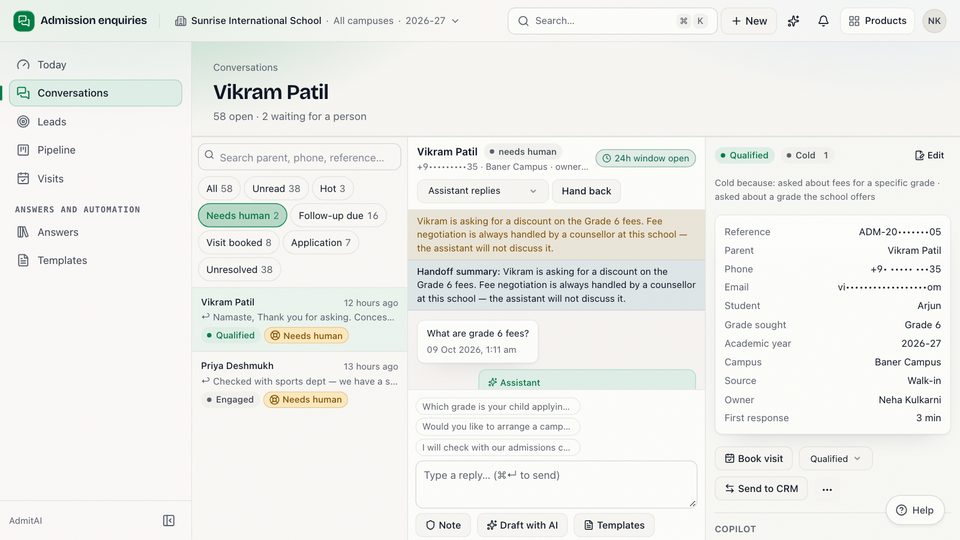
The assistant answers only from entries in the school's knowledge base that a person has verified, and a reply that does not cite one is rejected. It hands the conversation to a counsellor when the question is on the human-only list, when nothing in the knowledge base matches, when two entries disagree, or when it is not confident. In autonomous mode the parent is told the conversation is going to the admissions counsellor rather than given a guess.
The picture at the top of this article is such a handoff in the demo school: a parent asks about a discount, and the summary says fee negotiation is always handled by a counsellor.
WhatsApp's own rule applies too: free text only within 24 hours of the parent's last message (72 hours after a click-to-WhatsApp advertisement), and an approved template after that.
3. Call only the enquiries a person chooses, never one who opted out
An AI call starts only when a counsellor (or the owner) presses AI call on an enquiry in the admissions inbox. Campus One will not call an enquiry that is closed or a parent who asked not to be contacted, and each family goes through the AI admission calls only once; after that, follow-up is by hand.
The call is made by Vaani, the AI calling service. What it does on the call:
- it introduces itself as the school's AI assistant and says once, early, that it is an AI; if asked, it says yes and never claims to be human;
- it tells the parent the call is being recorded;
- it starts in Hindi and replies in the language the parent uses, including English, Hinglish and Marathi;
- it calls only between 10:00 and 19:00 India time;
- if nobody answers, it tries twice, an hour apart; if the parent is still deciding after a conversation, it follows up by itself up to three more times (one day after the first conversation, three days after the next and seven days after the one after that), and stops when the parent wants a visit, is not interested, gives a wrong number or asks not to be called.
There is no transfer to a person during the call. When a parent asks for one, the AI offers a callback from the team, and the call can be flagged "Needs a person soon".
After the call, the outcome is written back to the enquiry: wants to visit or apply, interested, asked for a callback, not interested, wrong number, or no conversation. Each outcome sets the counsellor's next action, for example "Confirm the campus visit the parent asked for on the AI call". A parent who asks not to be contacted is marked so, and is not called again.
Recordings are kept by the calling service for 90 days. Campus One does not store transcripts; it fetches them when someone opens the call, and records who opened it and who played the recording. The transcript screen warns that speech-to-text can mishear and that the recording should be checked before acting on anything important.
4. Book the visit: a person confirms
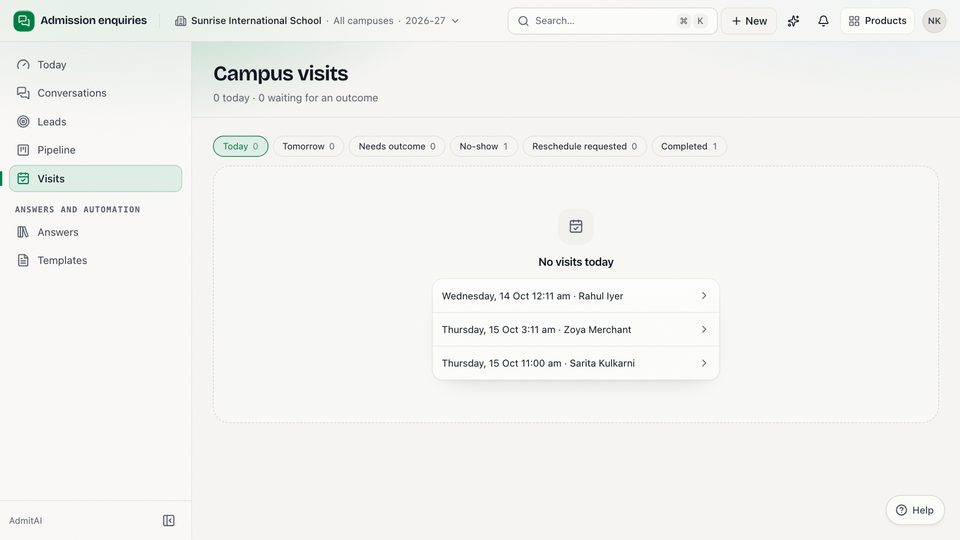
A visit is booked by a person with Book visit: campus, time, length (45 minutes by default), counsellor and a short visit brief that the counsellor reads before the family arrives. The enquiry moves to the campus visit stage and the timeline records it. If the AI proposes a visit, a person must confirm it, and it must be at least two hours ahead.
The visit desk shows today's and tomorrow's visits, visits that need an outcome, no-shows and reschedule requests. A no-show sets a next action to follow up and offer a new slot within 24 hours. Reminding the family the evening before is a person's job today: the visit-reminder rule on the automations page can be previewed, but Campus One does not yet send that reminder on its own.
5. Keep the queue honest
Each counsellor's day starts with work queues on "My day", such as "Campus visits today" and "Hot leads waiting more than a day". Follow-ups that are due or overdue sit at the top. The admission decision itself, offer or admission, is recorded by a person with that permission, never by the AI.
What the AI must never do
Write this list into your admissions policy, whichever software you use. Campus One's AI instructions say, in its own words:
- "Never invent a fee, discount, seat availability, admission decision, date or policy that is not in these facts. If you do not know, say the school office will call back with the answer."
- "Do not ask for documents, payment or the child's personal details on this call; the admissions office does that in person."
- Offer the next step (a visit) once, do not push it again unless the parent asks, and never suggest a day or time on its own.
- If the parent asks not to be called again, apologise, confirm the number will be removed and end the call.
On WhatsApp, some topics are never answered by software in any mode: fee discounts and negotiation, donations or capitation, the RTE 25% quota, special needs, medical needs or allergies, custody or legal matters, complaints and safety incidents, guaranteed seat promises, refunds and caution deposits, and comparisons with other schools.
What the demo shows, and what waits for keys
AI calls run on Vaani's test line until a real phone line is set up for the school: nothing rings, and the app says so ("AI call queued on Vaani's test line — nothing will ring", and "Test line — nothing rings" on the calls page). WhatsApp messages are recorded as simulated until the school connects its WhatsApp Business account. The demo school's families are made up.
Questions to ask about any admissions AI
- Who starts a call or a reply: a person, or a rule nobody watches?
- Does the AI say it is an AI, and that the call is recorded?
- Which topics does it always hand to a person?
- What may it never promise?
- Who books and confirms the visit?
- What does the screen say when a call or message is only a test?
The takeaway
Speed wins admissions, but trust keeps them. Capture every enquiry in one place, let the AI answer only what the school has approved and call only when a person asks it to, and keep the visit, the offer and the admission in human hands. The admissions page describes the pipeline, or you can explore the demo school, a read-only demo with made-up data.
Key takeaways
- Answer every enquiry the same day, but let a person own each one: software can remind, it should not decide.
- An AI assistant may answer only from facts the school has approved, and must hand anything else to a person.
- An AI call must say it is an AI, say the call is recorded, and never promise a seat, a fee, a discount or a date.
- A campus visit is booked and confirmed by a person; the AI can only ask for one.
Questions
Does Campus One call parents automatically?
Not on its own initiative. A call starts only when a counsellor or another permitted person presses AI call on an enquiry. After that first request, the AI calling service retries an unanswered call and follows up up to three times by itself. Closed enquiries and parents who asked not to be contacted are not called.
Can the AI promise a seat or quote a fee?
No. Its instructions forbid inventing a fee, a discount, seat availability, an admission decision or a date, and on WhatsApp topics such as fee discounts, donations, RTE seats and seat guarantees are always handed to a person.
Do AI calls ring real phones in the demo?
No. AI calls run on a test line until a real phone line is set up for the school, and the app says so: nothing rings.